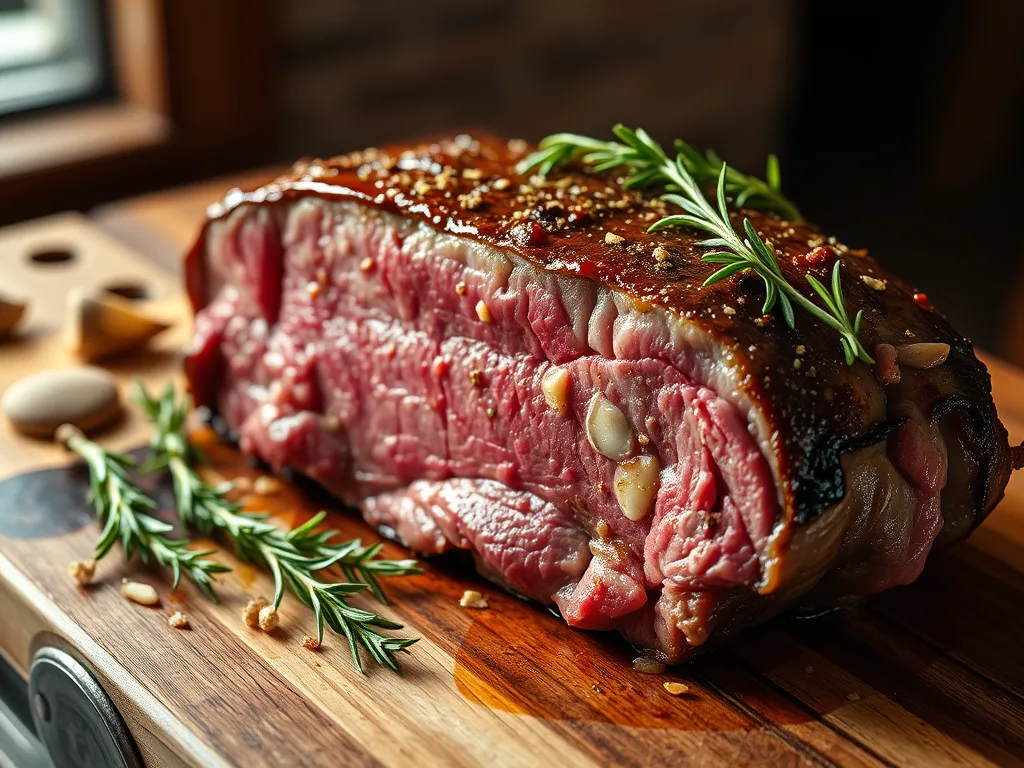
The Story Behind Roasted Prime Rib
Prime rib — the standing rib roast cooked to a blushing, pink interior — is one of the most magnificent expressions of the English roasting tradition. England’s devotion to roasted beef is ancient and passionate: by the Tudor period, roasted beef had become a national symbol, and foreign visitors to England marveled at the quantity and quality of beef consumed at English tables. The satirical figure of “John Bull” — the English everyman — was literally depicted eating vast quantities of roast beef, and the French nickname for the English, “les rosbifs” (the roast beefs), reflects how central roasted beef was to English national identity. The standing rib roast, with the bones left in to protect the meat and act as a natural rack, produces a roast of incomparable flavor.
In America, prime rib became the centerpiece of the mid-20th century steakhouse tradition. The “prime” in prime rib refers not to USDA Prime grade but rather to the primal cut from which it comes — the standing rib is one of the nine primal cuts of beef. The garlic-herb butter technique for finishing roasts has roots in classical French cuisine (compound butter, or beurre composé) but became thoroughly Americanized in the mid-century, when layering roasts with butter, garlic, and herbs before a hot sear became the standard approach. Prime rib as a Christmas centerpiece reflects the English tradition of grand celebratory roasts at holiday gatherings — a tradition maintained by the American descendants of English settlers and now observed by families of every heritage across North America.
My biggest tip for this roast — the one that changed everything for me — is to salt it generously and leave it uncovered in the refrigerator overnight before cooking. This dry-brining technique draws moisture to the surface, which then gets reabsorbed and seasons the meat deep into the muscle. The surface dries out beautifully, which means a more dramatic, crackling crust when it hits the heat. A meat thermometer is not optional here; it is the difference between a magnificent rosy pink center and an expensive mistake. Pull the roast at 120°F for rare, 128°F for medium-rare, and let it rest a full twenty minutes before carving. The bones act as a built-in insulator and will carry the heat further during the rest than you expect. Serve with the pan drippings whisked into a simple jus, and don’t forget the horseradish.
Time and Servings:
- Prep Time: 15 minutes
- Cook Time: 2 hours
- Total Time: 2 hours 15 minutes
- Servings: 6 servings
Nutrition (per serving):
- Calories: 450 kcal
- Protein: 35g
- Fat: 32g
- Carbohydrates: 2g
Ingredients:
- 5 lb prime rib roast
- 1/4 cup unsalted butter, softened
- 4 cloves garlic, minced
- 1 tbsp fresh rosemary, chopped
- 1 tbsp fresh thyme, chopped
- Salt and pepper, to taste
Instructions:
Prepare the Roast:
- Preheat the Oven:
- Preheat your oven to 450°F (232°C).
- Set a roasting pan or baking dish aside for the prime rib.
- Make the Garlic Herb Butter:
- In a small bowl, mix 1/4 cup of softened unsalted butter with 4 minced garlic cloves, 1 tbsp chopped rosemary, 1 tbsp chopped thyme, and a generous amount of salt and pepper.
- Stir until the mixture is smooth and evenly combined.
- Season the Prime Rib:
- Pat the prime rib roast dry with paper towels.
- Rub the garlic herb butter generously all over the roast, ensuring an even coating.
- Place the seasoned roast in the roasting pan, bone-side down if applicable.
Roast the Prime Rib:
- Start High Heat Roasting:
- Place the roast in the preheated oven and roast at 450°F (232°C) for 15 minutes to create a golden crust.
- Reduce Heat:
- Lower the oven temperature to 325°F (163°C) and continue roasting for approximately 1.5 hours, or until the internal temperature reaches:
- Rare: 120°F (49°C)
- Medium-Rare: 130°F (54°C)
- Medium: 140°F (60°C)
- Use a meat thermometer inserted into the thickest part of the roast to check the temperature.
- Lower the oven temperature to 325°F (163°C) and continue roasting for approximately 1.5 hours, or until the internal temperature reaches:
Rest and Serve:
- Let the Roast Rest:
- Remove the roast from the oven and tent it loosely with aluminum foil.
- Let it rest for 15 minutes to allow the juices to redistribute.
- Slice and Serve:
- Slice the prime rib into thick portions and serve warm as the centerpiece of your Christmas feast.
Tips for Success:
- Bring the roast to room temperature before seasoning for even cooking.
- Use a meat thermometer to ensure perfect doneness without overcooking.
- Save the pan drippings to make a rich gravy or au jus for serving.
Wine, Cocktail, or Drink Pairing:
- Pair this indulgent roast with a bold Cabernet Sauvignon, a robust Syrah, or a festive mulled wine for the ultimate holiday meal.